Terminology - Code Resolver Service
Healthcare data is riddled with codes that have meaning (eg. F for female, 24 for anthrax) and there are a number of third party applications (such as Carecom, Health Languages, Apelon and others) on the market that validate codes and map between various code sets such as ICD 9, ICD10, Snomed, Loinc, CPT/HCPCS, MSDRG, NDC, UCUM and others.
In Orchestral, this functionality built right in with the Code Resolver, which is one of the standard services of the ingest and output pipelines. This obviates the need for any additional software and associated costs.
Features
Translates codes to their associated values.
Built-in healthcare vocabulary and valueset libraries.
Retains all original data.
Extend existing code sets with custom code+value pairs.
How it works
Resolving codes
The Code Resolver Service will reference the configuration for each coded value or coded element it encounters to determine the correct valueset or vocabulary table to use to resolve the code.
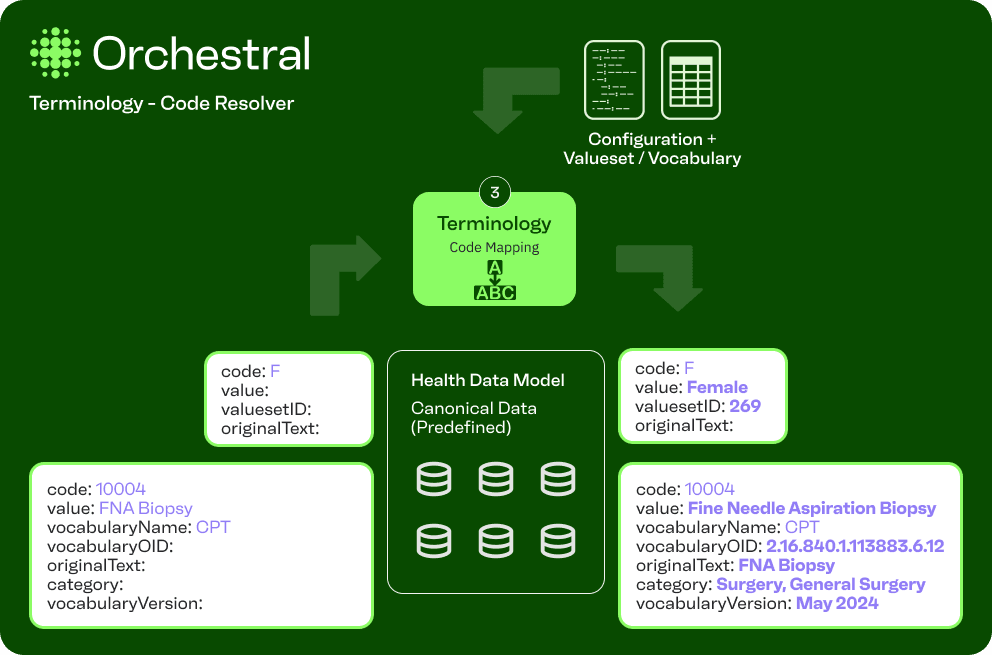
For coded values, this configuration is by data provider (in the Environment Manager), or if no specific configuration is set for the data provider, the default valueset setting from the ingest pipeline is used.
For coded elements, the name or OID (Object Identifier) of the vocabulary supplied in the original data item is used.
OIDs are used to uniquely identify medical vocabularies and terminologies, such as SNOMED CT or LOINC, and specific collections of codes known as value sets.
If the source data includes the code as well as a supplied value, that value is retained in the originalText field. This way we ensure no source data is overridden when we do the code resolution, especially where the supplied value does not exactly match the resolved value.
Customizing valuesets
The Code Resolver be extended with custom codes, or valueset overrides, where a data provider is using a standard valueset in a non-standard way, or is using their own codes entirely.
This is done via the Environment Manager application, and is applied to a specific provider on the pipeline.
What this means is that you can have multiple providers sending you the same type of data through the same pipeline (eg. Medicaid provider registry), but if one data provider is sending codes that aren’t in the standard valueset, you can add their additional codes without affecting the other providers.
Benefits
No need to look up codes in external libraries.
Improves analytics and reporting because codes are already translated when saved into the Health Data Model.